
 By Tom Joyce —
Ramsey Campbell says that if you want to write horror, never stop reading and learning from other authors. And don’t tell yourself you’re too experienced to need it. Ramsey still does it 60-plus years into a career as one of the world’s most influential and respected horror authors. In this month’s edition of Nuts & Bolts, Ramsey shares what he considers required reading for aspiring horror writers, provides writing tips, and offers career advice for anyone who wants to do this for a living.
Q: DO YOU HAVE ANY TIPS ON WRITING GOOD PROSE?
A: I don’t think there’s any shortcut to learning by reading it, however you define it. Within our field I’ve learned from examples as various as Lovecraft (the modulation of language in the service of specific effects, the orchestration of detail towards a crescendo), M. R. James (terseness of expression, his genius for distilling dread into a single sentence or even a solitary phrase), Leiber (the rediscovery of the urban landscape and contemporary life as sources of the uncanny rather than simply its setting or its victim) and Shirley Jackson (suggestiveness refined to an eloquent minimum). Outside it, Nabokov (relish of language in all its forms, not least dark humour startlingly applied) and Graham Greene (economy of effect in depiction, prose he progressively pared down throughout his career). I admire Iris Murdoch for her pellucid linguistic clarity, but I don’t think I can claim much of that for myself.
Q: WHAT TECHNIQUES DO YOU USE TO SCARE READERS WITH NOTHING BUT THE WRITTEN WORD?
A: I’m not sure I’m the chap to ask, since I haven’t tried to do that for many years. My aim is simply to convey my imaginative experiences, not impose them on the reader, though it’s true they usually involve disquiet or something stronger. I think by now whatever methods I use have become instinctive. To the extent that I can analyse them, let’s see. Choice of language I find crucial. Often relatively neutral words can work as well as more floridly expressive ones, but I’m not advocating flatness of style (though I did once write a tale — “A Street was Chosen” — wholly in the passive voice with no characterisation, and was intrigued to find it seems to work for people, even when read aloud). Structure is equally important to the build-up of gradual dread towards the revelation or the peak of terror (very often those are the same thing), and the point of transition to the latter needs to be carefully managed. Timing is as essential to horror as it is to comedy. Above all, though, engage your imagination; don’t just try to manufacture what you think will work on the reader. If you don’t feel it, why should they?
Q: CAN YOU GIVE ME SOME ADVICE ABOUT WRITING CHARACTERS?
A: I confess to approaching this instinctively and without much conscious technique. I increasingly find writing (novels in particular) to be a process of discovery. The more I write about the characters, the more they reveal themselves to me. I do need to know some things in advance, obviously — their names, what they do in life, their relationships — and until I’ve settled on those elements not just the characters are lost in a limbo of frustrating vagueness: I am too.
Q: HOW DO YOU CREATE AN IMMERSIVE SETTING?
A: My stories often develop from actual locations, and I search them for telling details I can use. Alternatively, if I’ve sought a place to set a particular story, I’ll go and look whenever I can. There’s always something there you can use that you wouldn’t know about without researching.
Q: WHAT WOULD YOU CONSIDER TO BE REQUIRED READING FOR BEGINNING HORROR AUTHORS TRYING TO LEARN THE CRAFT?
A: The classics — certainly that’s how it worked for me. Elsewhere I tried to sum up some of the continuity thus: Poe and Le Fanu refined the Gothic novel, rendering it terser and more psychologically focused. M. R. James stripped Le Fanu’s methods to their absolute essence, developing his own genius for the spectrally suggestive phrase or sentence. Writers such as Walter de la Mare and Lovecraft learned from Poe. Lovecraft also subsumed the influence of writers such as Blackwood and Machen. Fritz Leiber united the traditions of M. R. James and Lovecraft. T. E. D. Klein does too, but Machen also comes to the fore in some of Ted’s finest work.
Shirley Jackson distils terror from a new concentration on understatement. Stephen King rediscovers Poe for our time. Echoes of Robert Aickman can be found in M. John Harrison’s profoundly personal fiction, and in Lisa Tuttle’s and Terry Lamsley’s — not to forget Reggie Oliver, surely our most elegant stylist and a great upholder of the best traditions of the field. Thomas Ligotti’s tales can be Lovecraftian, but they are remarkably unlike anybody’s work other than the author’s, although Mark Samuels has an equally distinctive worldview that earns him the comparison.
Ray Bradbury and Richard Matheson brought contemporary concerns to the field and revived close psychological realism, and their ground-breaking influence can be seen not just in Steve King but in the excellent Dennis Etchison. The overlap with crime fiction deserves an essay in itself; one excellent contemporary practitioner is Steve Mosby.
Q: WHAT ADVICE WOULD YOU GIVE SOMEONE WHO WANTS TO BE A PROFESSIONAL WRITER?
A: One of the best pieces of advice about writing I ever received was from August Derleth early in our correspondence: “Well, since you are only 15 — the age I was when my first story was printed in WEIRD TALES — you surely have a promising career ahead of you in writing.
Don’t be trapped, though — I mean, don’t depend on writing alone to make you a living. I did, and while I managed to fare well by leaning on my parents for ten years, I don’t recommend it; when you’re out of school get yourself a decent, not too harrowing job, and write as much as possible.” He was right, to put it mildly.
I didn’t go fulltime as a writer until eleven years after my first professional publication, and then my wife Jenny brought in most of the money for the next six years or so. It took me that long to gain any substantial commercial success — seventeen years in all. Still, perhaps some of you reading this may improve on that. Good luck to everyone!
Q: DO YOU HAVE ANY PROJECTS YOU’D LIKE HWA MEMBERS TO KNOW ABOUT?
A: PS Publishing will bring out a limited edition of “Demons by Daylight” this summer, including all the first drafts as an extra. They also recently published a somewhat expanded version of “Six Stooges and Counting,” my tribute to the comedy team. In November Flame Tree Press have my new novel “Ancestral.” They’ve just reissued my novel “Incarnate” and have a bunch of other titles in their catalogue.
Q: WHERE CAN PEOPLE FOLLOW YOU ONLINE?
A:
- https://ramseycampbell.com/
- https://www.facebook.com/ramsey.campbell.75
- https://x.com/ramseycampbell1
- https://bsky.app/profile/ramseycampbell.bsky.social
 |
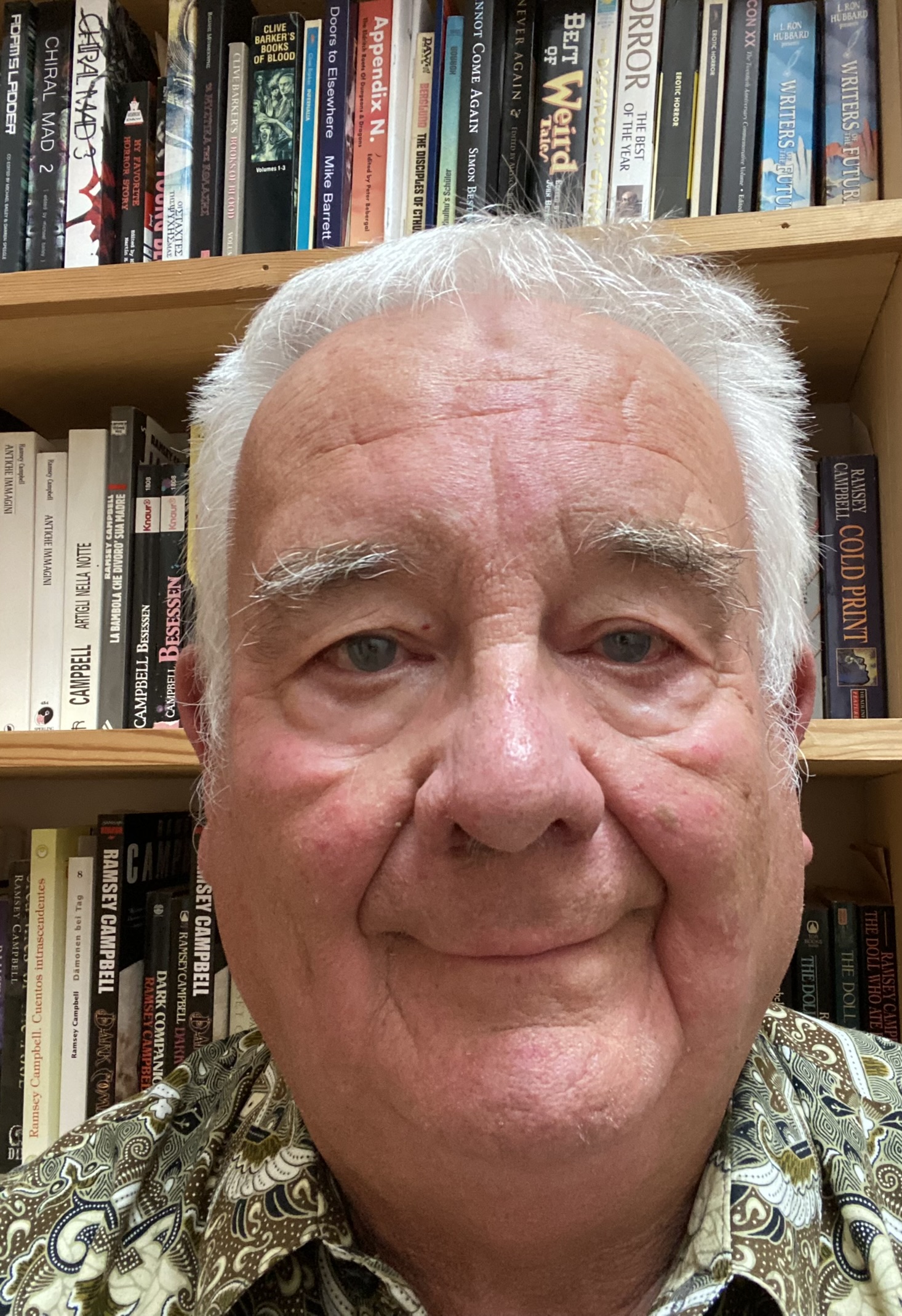
RAMSEY CAMPBELLRamsey Campbell has been given more awards than any other writer in the field, including the Grand Master Award of the World Horror Convention, the Lifetime Achievement Award of the Horror Writers Association, the Living Legend Award of the International Horror Guild and the World Fantasy Lifetime Achievement Award. In 2015 he was made an Honorary Fellow of Liverpool John Moores University for outstanding services to literature. Among his novels, and available from Flame Tree Press, are “An Echo of Children,” “Thirteen Days by Sunset Beach,” “The Wise Friend,” “Somebody’s Voice,” “Fellstones,” “The Lonely Lands,” “The Incubations,” “Incarnate,” and his “Three Births of Daoloth” trilogy: “The Searching Dead,” “Born to the Dark” and “The Way of the Worm.”
|
Tom Joyce is a volunteer and affiliate member who writes a monthly feature for the HWA blog called “Nuts & Bolts,” featuring interviews about the craft and business of writing. Please contact him at TomJHWA@gmail.com if you have suggestions for future interviews.