April 2026
Kate Maruyama, Member of the Diverse Works Inclusion Committee.
The sole purpose of The Seers’ Table monthly column is to introduce HWA members to the work of underrepresented demographic writers and editors whose work might not otherwise be viewed, using the broadest definition of the word underrepresented to include, but not limited to, gender, gender identity, race, ethnicity, sexual orientation, disabled and neurodiverse.
You can see any of The Seers’ Table posts since inception (March 2016) by going to the HWA main page and selecting the menu item “HWA Publications / Blogs / Seers’ Table”.
Linda D. Addison recommends:
EC Dorgan writes weird fiction and horror stories on Treaty 6 territory near Edmonton, Canada. She loved to write as a child, but only started writing as an adult after moving back home during the pandemic. Since then, EC has had close to 30 short stories published in magazines such as The Dark, Augur, The Skull & Laurel, and Cosmic Horror Monthly, and in anthologies such as Northern Nights (Undertow Publications), Were Wolf Short Stories (Flame Tree Publishing), and Afterlives: The Year‘s Best Death Fiction (Psychopomp).
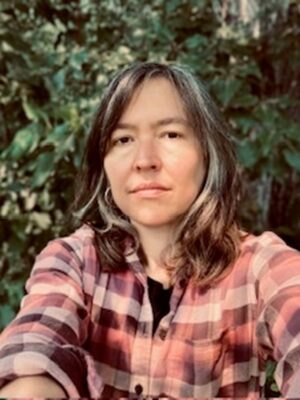
In 2024, Writers’ Trust Canada named her a “Rising Star,” and in 2025, she received the Alberta Literary Award for Short Story. EC is a member of the Métis Nation of Alberta.
Recommended Reading: Prairie Teeth (The Dark Magazine, Sept. 2025;
https://www.thedarkmagazine.com/issues/september-2025/)
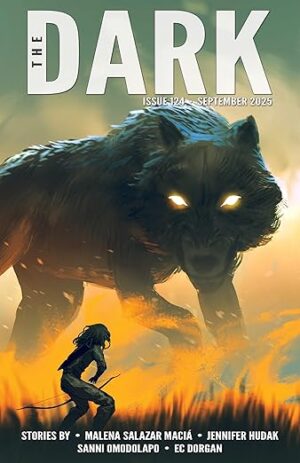
Excerpt from Prairie Teeth (first published in Northern Nights, ed. Michael Kelly (Undertow Publications, October 2024))
When Halloween comes, she doesn’t bother with an Etsy sweater. She keeps the air purifier off. She walks to the window and looks outside. The moon shines bright and the field is cold and barren.
She almost misses the knock.
Her heart skips. She almost trips in her rush to the door. She opens it wide.
He’s still dressed like a lumberjack. He takes off his Stetson.
“About that coffee?”
It’s only French press but he takes it.
He smokes his pipe and cracks his knuckles.
“Playing cards, fiddle?”
She threw her cards out years ago—tired of playing alone. And she flunked out of violin in grade three for playing crooked.
“I have potatoes.” Her cheeks burn when she says it. Two years to think of something—and this?
“Dice then.”
He puffs an “O.” Takes off a leather glove and smiles at her. He reaches into his maw while she watches. Pulls out his hand and opens his palm.
Two dice. She thinks.
She’s never played dice, but it can’t be that different from cards or bingo. She knows those. Her grandma taught her.
She sits down. The thorns in her hand are killing her. She reaches for the dice but he closes his fist.
“We play with four.”
He opens his palm. She jumps backwards.
Teeth.
Her gums throb at the sight of them. She looks up.
He puffs his pipe, grinning.
She should say, “Enough.” Shoo the Devil out into the cold, where he came from. She breaks out in a sweat. The paperback heroines are never this desperate.
But she’s tired of hoeing potatoes. Living vicariously through books. Tiptoeing like a ghost. Holding onto thorns just to feel something.
She nods and the room shifts.
He holds out pliers and she takes them. The metal is heavy. She fits them into her mouth and winces when they brush a filling.
You can find EC Dorgan at: http://www.ecdorgan.com/
Geneve Flynn recommends:
Anna Taborska was born in London, England. She studied Experimental Psychology at the University of Oxford and was later awarded a scholarship to study directing and screenwriting at the Polish National Film School.
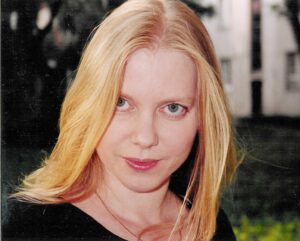
She has written and directed two short fiction films (Ela and The Sin), two documentaries (My Uprising and A Fragment of Being), and a festival award-winning TV drama (The Rain Has Stopped). She has also worked on twenty other films, with actors such as Rutger Hauer, Noah Taylor, and Jenny Agutter, and was involved in the making of two major BBC television series: Auschwitz: the Nazis and the Final Solution and World War Two Behind Closed Doors – Stalin, the Nazis and the West.
Her stories have appeared in over fifty anthologies, including Ellen Datlow’s The Best New Horror of the Year, Volume Four (2012, Night Shade Books) and Nightmares: A New Decade of Modern Horror (Tachyon Publications, 2016), and in three single-author collections: Bloody Britain (Shadow Publishing, 2020), Shadowcats (Black Shuck Books, 2019), and For Those who Dream Monsters (Mortbury Press, 2013, 2020).
Her short story “Little Pig” won the Bloody Flicks Awards Best Short Story award in 2019, and has its own fan club (Fans of Little Pig – FOLP), started by two officers of the Virginia Port Authority Police Department in 2012.
She was nominated for a British Fantasy Award three times, and for a Bram Stoker Award six times, including for her illustrated book A Song For Barnaby Jones (Zagava 2022), and for a British Fantasy Award three times. Her debut collection won the Dracula Society’s Children of the Night Award and she co-edited the Stoker Award-winning anthology, Discontinue if Death Ensues (Flame Tree Publishing, 2024).
She is currently Co-Head of Programming for the Raindance Film Festival, where she has introduced a dedicated Horror strand.
Recommended Reading: “[Ir]reversible,” published in Witches and Witchcraft, Hippocampus Press. Anna’s short story is a 2025 Bram Stoker Award finalist.
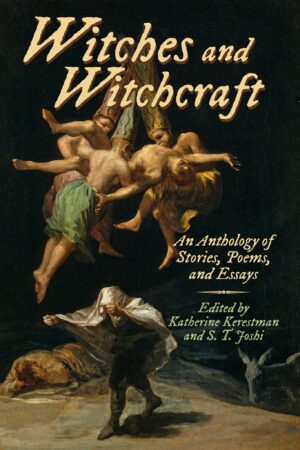
Excerpt from “[Ir]reversible”:
VIGNETTE 3
In the fading light of early evening, the shapes standing in the middle of Southfield Park could have been anything. From a distance, the five rough, upright sticks with something ragged perched on top, seemed like an unsettling art installation, unusually placed to provoke thought. Some passersby, catching them out of the corner of their eye while hurrying along the paths of the small park in West London, might have thought they were scarecrows for some odd, temporary display or even the remnants of strange, exotic plants. Others might have dismissed them as discarded pieces of trash, caught in the wind and snagged on sticks left by unsupervised children.
But curiosity pulled a few people closer. A couple of joggers slowed their pace, squinting in the burgeoning gloom as they tried to make sense of what it was that they were looking at. Dogwalkers paused, pets tugging frantically at their leashes. As people neared, the outlines became sharper, the details clearer, and a sense of unease began to creep in. The things skewered atop the sticks were not sculptures or weird plants, but something much more disturbing.
They were heads – human heads – impaled on the coarse, splintered wood. The hair, matted and dark with clotted blood, clung to the scalps like the brittle legs of dead insects, rustling faintly in the breeze. The skin, pulled tight over the skulls, reflected the dim streetlights with a sickly, unnatural sheen, like the exoskeletons of massive beetles. What first appeared to be hollow sockets in a bizarre piece of art revealed themselves to be sunken eyes, staring out blankly into the growing night.
You can find Anna at: https://annataborska.wixsite.com/horror
Or on IMDB at: https://www.imdb.com/name/nm1245940/
Author photo credit: Michael Fleming
Kate Maruyama Recommends:
Felix I.D. Dimaro. Born in Nigeria, raised in Toronto, Felix I.D. Dimaro is an author of allegorical, dark, psychological fiction often centering around morality, mental health, societal conditions, the environment, or the real-life issues he has experienced. He has released twelve books to date, including the eco-thriller, “Black Bloom: A Story of Survival,” the extreme horror novel, “Humane Sacrifice: The Story of the Aztec Killer,” and the tale of cat cloning gone wrong, “In the Darkness, Eyes and Teeth.”

When not writing, Dimaro is usually reading, watching professional wrestling, or running even though no one is chasing him.
On Elizabeth Broadbent’s substack interview, Dimaro said, “I believe that stories are meant to speak to societal concerns; to provide education even if indirectly. I aim to have a valuable societal lesson in each of my stories without moralizing to readers. I try to put forth my ideals and concerns in a way that might encourage those ‘on the other side’ to reconsider their stance without feeling they are being belittled or shamed about what they currently believe. It’s a difficult thing to do because you see the state of things and just want to yell at people for being daft. But when it comes to politics in stories, I find that allegory and subtlety tend to work better than admonishment.”
Recommended Reading: Daily Special: A How to Make A Monster Anthology (Infinity Road Publishing, 2023)
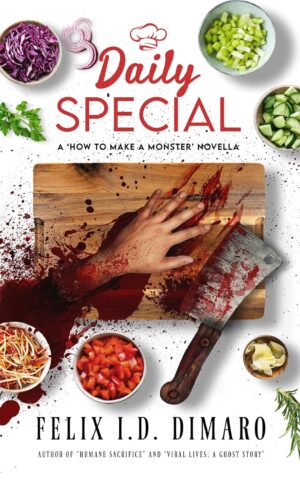
Excerpt: From Daily Special: a How to Make a Monster Novella
For every time his knife betrayed him and opened his flesh, and for every time he seared his skin, he became more and more incensed by his mother. She should have been the one to show him how to handle the knife and its cutting board: she should have been the one to show him which pot was best used to prepare which dish, but she wasn’t that person. He resented her for that.
He would often stand over her prone, passed out body, smiling darkly while chewing contentedly on whichever recipe he had dared to bring to life during her slumber. On one particular night, he knelt beside her as his mouth was still working on a bite of that scratch-made hamburger that the television had told him was crucial to make. Lenny always wore a shawl in the house, and she usually kept a bottle of something hot beneath it, cradled between her torso and arm. On this night, he plucked that bottle from underneath one of her flabby arms, brought it to his lisp, and drew from it as though it were life-redeeming water.
Dimaro can be found at: https://www.thingsthatkeepmeupatnight.com/our-story
And you can follow him on Instagram: @thingsthatkeepmeupatnight
|


