


 Reviewed by E. F. Schraeder…
Themes: Middle school bullying and violence, homophobia, social exclusion, implied use of slurs, toxic friendship
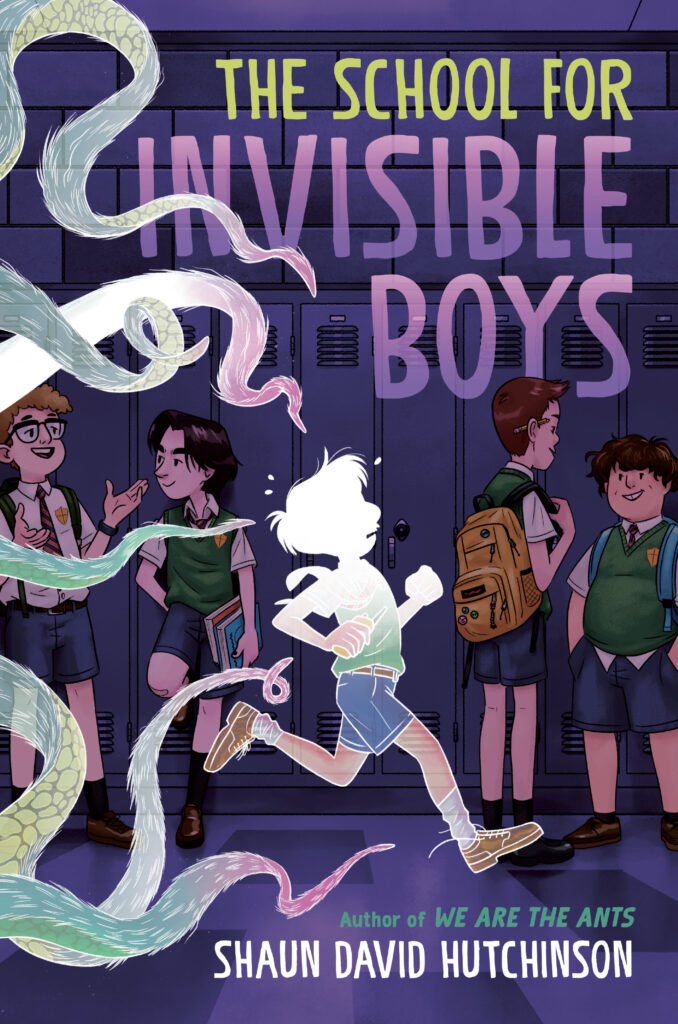
 Hector Griggs has two bad options. He can be seen and taunted for being himself or fade into the background, maybe forever. Turning invisible may sound like a twelve-year-old’s dream, especially when that twelve-year-old faces bullying. But invisibility unravels into a nightmare for Hector, who is seen quite clearly by the tentacled monster lurking in the shadows of his new school in the middle grade horror novel, The School for Invisible Boys.
Seeking respite from a home life where he’s already struggling with stepbrothers and a dad who would prefer he played sports, Hector’s life worsens when he asks Blake, his soon-to-be former best friend, to be his boyfriend. Blake’s response is an eruption of violence, a physical and verbal rampage of cruel homophobic bullying. As for Hector’s new school, it’s no safe haven either. In fact, Hector discovers early on that St. Lawrence’s Catholic School for Boys is a terrifically creepy building, complete with a terrifying monster known as a gelim.
When Hector becomes invisible, he meets another invisible former student, Orson, who is Black. Hector may be on the same path as Orson, whose life was basically erased. This exposes how some of the horrors sixth graders face are worse than supernatural monsters—like bigotry. As Hector and Orson team up, the two students marked as “Others” at a mostly white boy’s school realize they share one important thing. They’ve been ostracized. The sinister creature stalks the vulnerable students and threatens them both with getting stuck in invisibility forever.
And that’s the true threat in middle school. Being seen for who you are when you’re different and facing the consequences. Hector and Orson are made to feel they don’t fit in at school, but together, they have a chance to figure out what the tentacled monster in the school is after, and how to stop it. As for the monster, they discover it feeds on loneliness and fear; two ingredients that are available aplenty in the halls of most middle schools, at least in any one I’ve ever attended or visited.
On a personal note, like Hector, middle school also swept me into a whirl of anxieties, confusions, and fears. In terms of gender expression and sexuality, those years provided an unwelcome, immersive crash course that operated slowly and quickly, revealing the myriad of ways I was not like my peers. At times it felt like a nightmare mirror. Almost anything I did had the potential to reflect wrongly. Like Hector, I found that to be a time when friendships, activities, and interests seemed constantly tested and uncomfortably sorted into gender and social expectations that I didn’t grasp. Trying to decode and assess what it would take to “fit in,” which at that time largely involved either passing for straight or accepting assigned labels, homophobia, and subsequent stigmas. The realities were as terrifying and relentless as any old monster. To say I rooted for Hector on this journey, would be an understatement. I was right there with him.
As a horror read, The School for Invisible Boys is a thrilling middle grade option with themes of resilience and collaboration. The tight pacing and plot hinge on characters readers grow to care about quickly, and the social emotional importance of empathy and connections are fueled throughout the book. The age-appropriate scares include atmospheric vibes at school and a chilling monster, with Hector’s relatable problems of feeling out of place defining his experience of fear. While Hector delivers some retaliation to bullying, it’s a fair critique to note Hector forgives his former bestie rather quickly. But for me, that’s not the main point of the story. The emotional core of the story widens understanding of social exclusion and societal stigma, examines what it means to be a kind person in a world bent on punishing difference, and articulates the value of vulnerable feelings that accompany growth.
As such, one of the standout features of this book considered from a mental health perspective is defined by Hector’s sympathetic characterization. Middle school is a time of significant change, when it’s easy for a lot of kids to feel vulnerable and like they don’t belong. From intense bullying to subsequent anxiety, depression, low self-esteem, loneliness, and panic, the emotional fallout in Hector’s world is as real as the monster. As Hector’s fears become a material reality in the text, and this embodiment effectively builds tension and dread while increasing the importance of Hector’s resilience. Finding a way to cope with fear is part of what makes horror so valuable, especially for young readers. Hector’s journey plants hope, and in this respect The School for Invisible Boys shines.
 Shaun David Hutchinson lives in Seattle and has published over a dozen novels of YA fiction, including his recent works, Howl, A School for Invisible Boys, and A Home for Unusual Monsters. His work can be found here: https://shaundavidhutchinson.com
Goodreads Link: Little White Flowers by Amber Hathaway | Goodreads
E.F. Schraeder is author of The Price of a Small Hot Fire (Raw Dog Screaming Press, 2023), the Saturday Visiter Award nominee What Happened Was Impossible (Ghoulish Books, 2023), The Case for Cryptids (forthcoming, Raw Dog Screaming Press), and several other works.
