


HALLOWEEN HAUNTS: The Monsters We Invite In: Why Halloween Doesn’t Always Have to Be Scary
by David and Russell Dorn
Some monsters want to chase you. Some want to lurk under the bed. And some, if you give them a chance, just want to come to the Halloween party.
That last kind of monster has always interested us. Halloween is a holiday built around the strange and the supernatural, but there is room in it for more than one kind of fright. A jack-o’-lantern can look wicked in the dark and wonderfully goofy in daylight. A creaking door can announce a ghost—or somebody arriving with a bowl of candy. Half the fun is not knowing which it will be.
When we began creating Felipe Femur & Friends around 2015, we were drawn to the possibility of giving familiar Halloween creatures unfamiliar lives. We knew the usual cast: skeletons, witches, vampires, werewolves, and other things that go bump in the night. What if, instead of asking what these monsters could do to frighten people, we asked what they might do on an ordinary afternoon? What would make them laugh? What would embarrass them? Who would they call a friend?
A skeleton is a good place to start. In a traditional spooky story, the skeleton usually signals that something has gone terribly wrong. Felipe Femur, on the other hand, would much rather spend time with his friends, solve a puzzle, or enjoy a little peace and quiet. He’s a skeleton, and that matters to his appearance, but it doesn’t have to decide his personality. His bones are the beginning of the character, not the whole character.
The rest of the gang follows the same wonderfully crooked logic. Gummy is a werewolf with an enormous appetite and no teeth. Sunny is a vampire who loves sunshine. Gilli is a creature of the water who happens to be afraid of water. Runny, our witch, is as likely to be busy with a peculiar recipe or playing music as casting a spell. Their monstrous traits invite a second look, but their everyday problems make them feel like neighbors.
We don’t think that takes anything away from Halloween. If anything, it lets the season stretch its legs. Monsters have always been flexible. They can stand for danger, for the unknown, for things we don’t understand, or simply for the delight of putting on a costume and becoming someone else for an evening. The same vampire can be terrifying in one story and a surprisingly good friend in another. Both versions belong to the tradition.
Children understand that flexibility better than we sometimes give them credit for. Put on a monster mask and a child can become the thing that, moments earlier, might have made them nervous. The claws are pretend. The cape is a towel. The growl ends in laughter. That is one of Halloween’s neatest tricks: it gives us permission to approach the frightening at our own speed, and to turn it into play when we’re ready.
This doesn’t mean every children’s Halloween story should be free of suspense. A dark hallway still needs to be dark. A mysterious sound ought to make somebody stop and listen. A good ghost story can give a child the delicious feeling of pulling a blanket up to their nose and wondering what happens next. But the writer can choose the kind of promise the story makes. Sometimes that promise is a genuine shiver. Sometimes it is that, after the shiver, someone will open the door and discover a friend.
For us, the interesting part of writing friendly monsters is finding that balance. Make everything too sweet, and you lose the wonderful oddness that brought the characters to life. Make everything too frightening, and you may close the door on the youngest audience. Somewhere between those extremes is a place where a spooky setting can hold a silly misunderstanding, a real mystery, or even a small moment of kindness.
The world around Felipe has changed considerably since those early years. In 2026 we rebuilt and relaunched the project, bringing together stories, comics, music, browser games, and creative activities in a shared home. Different kinds of storytelling make us look at the same characters from new directions. In a story, a monster can reveal a secret. In a game, that monster can give you a puzzle to solve. In a song, the monster might finally get to make a little noise. The characters stay themselves even as the form changes.
There is something especially fitting about this for Halloween. The holiday has never belonged to just one medium. It lives in neighborhood decorations, homemade costumes, scary stories, cartoons, songs, movie nights, and the one house on the block that always goes overboard. Everyone approaches it differently. Some people want to be scared out of their socks. Others want a painted pumpkin, a corny joke, and a friendly ghost. A generous Halloween has space for both.
We love the shadows, the creaky floorboards, and the unmistakable sound of someone whispering, ‘Did you hear that?’ But we also like the thought that the creature waiting on the other side might have a completely ordinary problem: a lost shoe, a ruined recipe, or a friend who forgot to knock.
After all, the best monsters are the ones that stay in our imaginations long after we take down the decorations. Some stay because they scared us. Others stay because we grew fond of them. There is no reason a skeleton can’t do both.
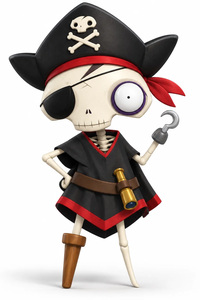 David and Russell Dorn are twin brothers and the creators of Felipe Femur & Friends, an original world of kid-friendly Halloween monsters first developed in 2015 and substantially relaunched in 2026. Their characters appear in comics, stories, music, games, and activities for families. Explore the project at https://www.felipefemur.com/ and watch videos at https://www.youtube.com/@FelipeFemur.