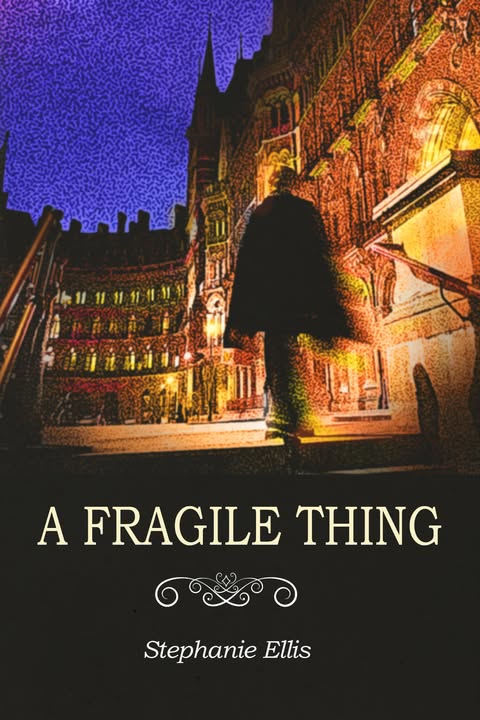

 Reviewed by Lee Murray
Released 17 March 2026 from Watertower Hill Publishing
Triggers: Mental illness, suicide ideation, violence.
Victorian London.
Isaac Bercow is a man with great aspirations, nothing to lose, and an offer he can’t refuse. Determined to make society notice—and believe in—his powers of mesmerism, Isaac finds himself caught in a trap of deceit, danger, and diabolical dealings.
The mind is a fragile thing, and fragile things are easily broken.
The mind is a fragile thing. Nothing could be truer. And it is that tender balance of the mind that Stephanie Ellis explores in her Victorian gothic chiller, A Fragile Thing, a narrative I believe will resonate with horror readers for its authentic and sensitive portrayal of mental illness while not diluting any of the horror we love.
As the blurb reveals, the story tells of Isaac Bercow, an arrogant mesmerist, who craves entry into the upper classes of Victorian society and validation of his hypnotherapy practice as a worthy scientific endeavour. Encountering a master who has determined how to step out of one’s body to delve into the minds of others, Bercow learns the secret at his own cost when dark entities are unleashed in his mind. Until he can convince the master to free him, the only way Bercow can quiet the voices is to offload individual entities to another host, one of whom includes a local doctor named Llewellyn. Bercow struggles to maintain control of his own mind, but he can keep no secrets from the intruders, and the dark acts they force him to carry out threaten his dreams of ascending to the upper classes. As time goes on and the line between madness and lucidity blurs, Bercow questions if his actions are truly driven by the shadows or evidence of his own corruption.
Ellis explains the inspiration for her novel (and the short story on which it is based) in a 2026 blog post which includes this snippet from her research.
Franz Neukomm, an Hungarian hypnotist, was attending a séance at the castle of Tódor Salamon in 1894. His twenty-two-year old daughter, Ella, had previously appeared with Neukomm and, under hypnosis, had apparently been able to solve events such as murder and theft.
On this particular occasion, however, Neukomm directed Ella’s soul to leave her body and travel a distance and enter the body of an ill man. This she did and related details of the man’s illness to the audience. But when she reported the probable outcome of the man’s disease, she collapsed and died.
An investigation was launched by the authorities to see if this was in fact a ‘death by hypnotism’. Neukomm was initially convicted of manslaughter but then cleared. She had died of heart failure which could have happened at any time. It was just an unfortunate coincidence.
The incident above is likely the reason for Ellis’s decision to set her story in Victorian England, where societal constraints such as poverty, ignorance, and lack of access to healthcare make it the perfect setting for a story about the monsters of mental illness. Even upper-class women of the day struggled with mental anxiety arising from limited freedom and unending boredom, ultimately leading them to seek out the mesmerist for entertainments which might simultaneously resolve their maladies (both real and imagined). In Victorian society, the fear of madness was real, since unlike today, effective treatments were rare and people with mental illness were often sequestered away in asylums where they might be subjected to restraint, cold baths, sedation, or experimentation. Ellis’s description of the asylum in the novel has echoes of Ann Radcliffe’s gothic style:
“Now the asylum loomed over them, majestic in its isolation, a grim and foreboding presence that appeared to offer no warm welcome to any who should come upon it. The dreary walls rose smooth and high, unrelieved by windows and ornamentation, a blank faceless monster waiting to devour any who would choose to visit.”
The sordid streets of Jack the Ripper’s Whitechapel and the filthy waters of the Thames help Bercow and Llewellyn to conceal their nighttime activities, and here Ellis does not hold back the horror. However, she is careful to compartmentalise the monstrous acts of her characters’ inner demons from the characters themselves. While Isaac Bercow isn’t the nicest fellow, fully intending to deceive his clients, the voices, hallucinations, and the lost time he experiences in the narrative are presented as being beyond his control, and it is this uncertainty, this inability to trust himself, that inspires fear and drives his actions. Ellis achieves this by couching mental illness in metaphor, using a mix of disembodied voices of the demons (dialogue) and internal thought of the host to highlight the turmoil going on in Bercow’s mind.
Desperate to stop the voices in their heads and the demons’ awful demands, both Bercow and Llewellyn consider suicide. This aspect rings true since studies suggest that people with mental illness are more likely to harm themselves—through self-injury or suicide—than they are to harm others. Also addressed in the novel are the shame and fear experienced by those afflicted with mental illness. Ellis clearly understands that stigma and prejudice are powerful motivators, and those characters inflicted by inner shadows will do anything in their power to prevent others from discovering their affliction. They rent lonely out-of-the-way rooms, roam the streets at night, and lie with abandon to hide their affliction, becoming more and more isolated over the course of the novel. Finally, snippets of Bercow’s backstory hint at a deeper trauma, which allows Ellis to guide us to the twist in the tale, making readers wonder what was true and what was merely hallucination.
In my view, her careful research and beautiful, terrifying prose make Stephanie Ellis’s A Fragile Thing a positive portrayal of mental health in horror and an excellent candidate for an HWA Notable Work.

Lee Murray ONZM is a writer, editor, poet and screenwriter from Aotearoa New Zealand, a Shirley Jackson Award and five-time Bram Stoker Award® winner. A USA Today bestselling author with more than forty titles to her credit, Lee holds a New Zealand Prime Minister’s Award for Literary Achievement in Fiction and is an Honorary Literary Fellow of the New Zealand Society of Authors. Among her works are feature film Grafted (Propaganda-Fluroblack) directed by Sasha Rainbow, horror anthology This Way Lies Madness (Flame Tree Press) co-edited with Dave Jeffery, and Oversight: Erasure Poetry (RIZE) a collaboration with Carina Bissett. www.leemurray.info
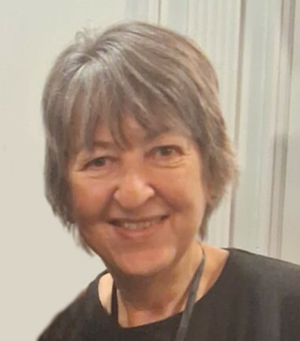 Stephanie Ellis writes dark speculative prose and poetry. She is the author of The Five Turns of the Wheel, Reborn, The Woodcutter, Harrowfield, The Barricade, A Fragile Thing, and novellas Bottled, Paused and Rat-She. Her short stories appear in a variety of magazines and anthologies, some of which have featured on Ellen Datlow’s Best of Horror Recommended Reading Longlist. She is a Rhysling and Elgin-Award nominated poet and has co-authored Mason Gorey (a novella in verse) and Lilith Rising with Shane D. Keene and Foundlings with Cindy O’Quinn. She can be found at https://stephanieellis.org and on bsky: stephellis.bsky.social