HALLOWEEN HAUNTS: The Pleasures of Halloween Graphics
by Lisa Morton
A couple of years ago, Spirit Halloween debuted a line of retro face masks in their stores at about the same time that Target was selling blow-mold decorations plainly modeled on 1960s styles. Publishers were bringing out books that collected old graphics, apparel companies were licensing existing art for Halloween wear, and artists were paying homage with their own modern takes on these classic graphics.
Apparently I’m not the only one who’s a sucker for the old look of Halloween.
I love an image of a big orange jack-o’-lantern face, a gleeful witch on a broom, or a black cat with wide eyes. I mean, I love pretty much all Halloween art – heck, one wall of my office is dedicated to it – but whether it’s from nostalgia or just how my particular taste leans, I especially adore Halloween graphics produced mostly in the middle of the last century.
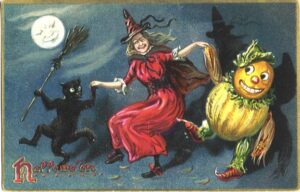
Consider first: Halloween postcards. From about 1910 to 1925, there were around 3,000 different Halloween postcards produced. This was during the time that the telephone still hadn’t made its way into every American home, and postcards were a cheap and fun way of staying in touch with friends and family. Halloween postcards, many of which were painted by gifted artists like Ellen Clapsaddle or Bernhardt Wall, were often colorful and playful, featuring anthropomorphic pumpkin people or gleeful crones on brooms.
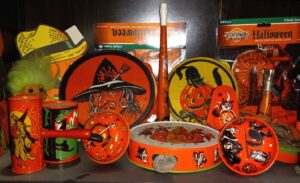
By the 1950s, postcards had diminished in popularity but trick or treat was booming, and kids’ costume accessories became the new source of delightful Halloween art. Metal noisemakers were popular (employed by trick or treaters to announce their arrival or by pranksters to irritate their victims), and they often featured beautiful line art in orange, green, and black colors; witches, black cats, and owls were all common themes. Trick or treat bags also featured lovely graphics, often showing cartoon-style renderings of costumed tots.
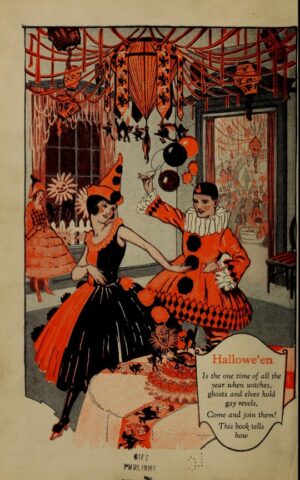
Several companies, especially Dennison’s and Beistles, produced paper decorations throughout the twentieth-century, many of which have become genuine classics that are still reprinted. Dennison’s also made the highly-prized “Bogie Books” from 1909 to 1926 (they continued on after that although they were simply put out as “Party Magazines”); these little pamphlets are crammed full of glorious drawings illustrating the decorations.
Advertisements are one other source of glorious retro Halloween graphics. Throughout the 1950s and 1960s in particular, candy companies and others bought full-page ads in magazines or created eye-popping in-store displays that contained graphics designed to stop shoppers in their tracks.
All of these materials are now much sought-after as collectibles, often bringing hundreds or even thousands of dollars in the resale market, and satisfying the nostalgic itch of Halloween collectors everywhere. For those with an interest in Halloween history, though, they provide a visual overview of a holiday that has always depended on presenting certain themes and colors in the most visually-pleasing form possible. These graphics serve to document Halloween’s evolution across the decades, helping us to understand how the holiday has transformed and grown.
Perhaps most importantly, though: they’re just plain fun. There’s a reason these mid-century styles keep getting resurrected and re-purposed by major retailers. They remind us of Halloween’s vibrant, joyfully macabre spirit…and who doesn’t love that?
Lisa Morton is one of the world’s leading authorities on the history of Halloween. Find out more at https://lisamorton.com/ or follow her at https://lisamorton.substack.com/ .
GRAPHICS:
VINTAGE POSTCARD:
NOISEMAKERS:
A PAGE FROM THE 1920 BOGIE BOOK: